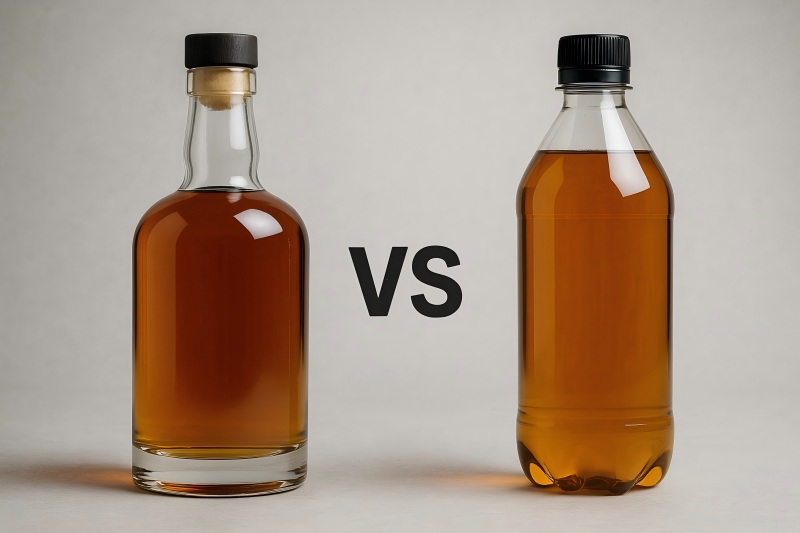
Glass Liquor Bottles vs PET: Which Offers Better Shelf Life and Brand Value?
In the alcohol industry, packaging is a key message. The choice between glass and PET bottles impacts product quality, brand perception, and sustainability. This article compares glass and PET for liquor bottles, evaluating preservation, cost, practicality, environmental impact, and brand positioning to guide producers in selecting the best material for their product and strategy.
Why Packaging Material Matters for Liquor
Liquor — whether spirits such as whiskey, vodka, gin, or premixed cocktails — often aims for long shelf life, stable flavor and aroma, and a premium feel that aligns with brand image. Key packaging requirements include:
- Chemical inertness: No interaction between container and liquid, so flavor/aroma remains intact.
- Barrier properties: Low permeability to gases (oxygen, CO₂) and moisture to prevent oxidation or flavor loss.
- Durability during transport and storage.
- Visual and tactile appeal for consumers — first impressions count.
- Cost, logistics, sustainability, and regulatory compliance (e.g., recyclability).
The material chosen has a direct impact on all these factors — hence, glass and PET each bring tradeoffs.
Fundamental Differences: Glass vs. PET
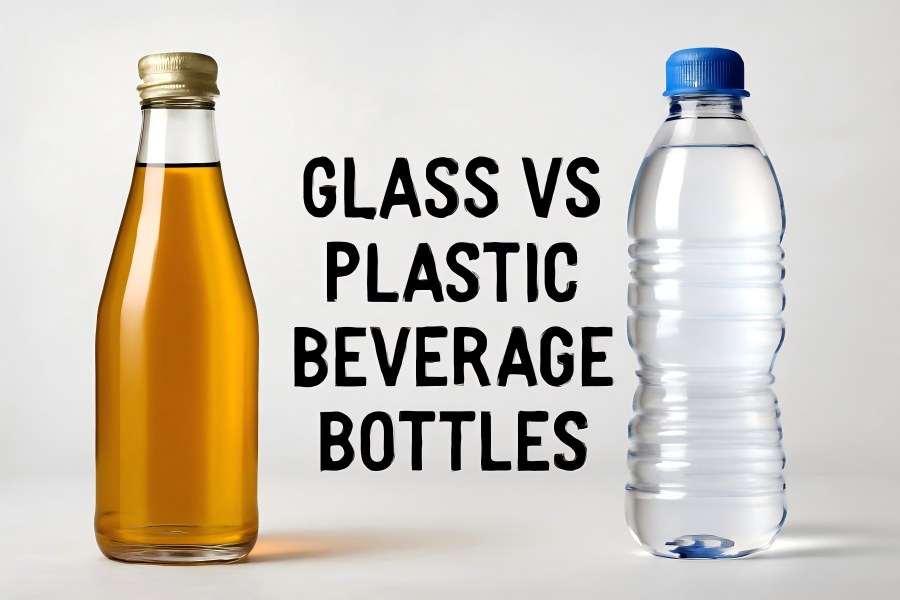
Here is a broad comparison between glass bottles and PET bottles, tailored for alcoholic beverages:
| Property / Feature | Glass Bottles | PET Bottles |
| Chemical inertness/reactivity | Chemically inert — does not react with contents; preserves flavor integrity. | PET is generally safe and food-grade, but polymers may have an affinity for hydrophobic flavor compounds; potential for slow absorption/adsorption, affecting taste. |
| Gas & moisture barrier (oxygen, CO₂, vapor) | Excellent barrier — virtually impermeable, minimal oxygen ingress or gas exchange. | Lower barrier than glass; some oxygen and vapor transmission may occur, potentially affecting oxygen-sensitive beverages over time. |
| Physical weight & fragility | Heavy, fragile — prone to breakage during shipping/handling, increasing losses. | Lightweight, shatter-resistant — much lower shipping cost and risk of breakage. |
| Production & transport cost | Higher costs due to weight, fragility, and energy-intensive manufacturing. | More cost-efficient — less raw material per bottle, cheaper transport and handling. |
| Environmental / Sustainability profile | Glass is fully recyclable and can be reused; its recyclability is well-established. | PET generally has a lower carbon footprint in production, lower transport emissions (due to lighter weight), and is recyclable (though recycling infrastructure differs by region). |
| Brand perception / Premium image | High-end, classic, premium feel — often associated with quality, craftsmanship, luxury. Common for spirits, wines, and premium beverages. | Seen as more “modern,” functional, sometimes mass-market or lower-end; may lack prestige but offers convenience and lower cost. |
| Flexibility in design (shape, color, weight, closure) | Traditional shapes and colors, but heavier and harder to customize; fragile restrictions on handling. | High flexibility — wide range of shapes, colors; lighter weight; easier to design complex or novel packaging; better for travel/portability. |
How Shelf Life & Quality Are Affected
Glass — the Gold Standard for Stability
Because glass is inert and impermeable, it provides excellent protection against oxygen ingress, moisture, and other contaminants. For spirits that are aged or stored for long periods, glass ensures minimal chemical interaction and maintains flavor and aroma integrity.
Glass tolerates temperature fluctuations effectively, and it does not distort or disintegrate under typical settings.
For products meant to be cellared, aged, or consumed over years, glass remains the safest and most reliable choice. This is why decades-old whiskies or premium liquors are almost always bottled in glass.
PET — Good for Short-to-Medium Term, Not Always for Long-Term Aging
PET bottles, while improved over the decades, still generally allow higher oxygen transmission compared to glass. That is critical for oxygen-sensitive beverages (e.g., wine, certain cocktails) and can reduce shelf life or lead to subtle degradation of aroma/flavor over time.
Additionally, as noted in polymer science, PET may have an affinity for hydrophobic flavor molecules, meaning over time some flavor compounds may be gradually absorbed into the plastic — potentially dulling taste.
For spirits, though, which are high-alcohol and less oxygen sensitive than wine, some producers claim acceptable preservation; for instance, a PET spirits bottle has been used successfully by certain distillers to ship whiskey-class liquor.
However, in general, PET is better suited for shorter shelf life products, lower cost spirits, or products meant for quick consumption rather than long-term storage or aging.
In other words, for maximum shelf life and taste preservation over time, glass is generally superior. PET can be acceptable but entails a higher risk of subtle quality degradation, especially for long-term storage.
Brand Value, Consumer Perception, and Marketing Position
Packaging isn’t just functional — it plays a crucial role in how consumers perceive the product. For liquor, where brand image, luxury, heritage, and craftsmanship often matter, packaging dramatically influences value.
Why Glass Enhances Brand Value
- Perceived Luxury & Heritage. Glass has a long tradition in spirits — from classic whiskey bottles to vintage-style decanters. Because of this, glass inherently carries a sense of premium, craftsmanship, and authenticity that aligns with high-end brands.
- Flavor Integrity and Product Confidence. Since glass doesn’t interfere with flavor or aroma, consumers are more likely to trust that what’s inside is the “real deal.” For aged whiskies, brand-story spirits, or premium liqueurs, this sensory integrity matters.
- Reusability & Sustainability Signals. Glass bottles can be reused, are recyclable, and have a “classic, sustainable” feel — this resonates with environmentally conscious consumers and supports premium branding.
- Premium Closure Options. Glass bottles can pair with corks, wax seals, and premium caps — adding to that luxury/uncompromised impression. PET, by contrast, often uses simpler screw-caps or plastic closures, which may look less premium.
Where PET Has Brand & Market Strength
- Cost-effective & accessible. For value-oriented or mass-market spirits, PET helps reduce costs — in production, transport, breakage — and allows competitive pricing without sacrificing too much on taste (especially for neutral or low-aroma products).
- Portability & Convenience. Lighter weight, shatter-resistance, and lower breakage risk make PET attractive for situations where portability matters: travel, festivals, outdoor events, or export to distant markets.
- Modern / Sustainable Positioning (when recycling is effective). PET has a lower production carbon footprint (less energy, lighter weight, lower emissions in transport) compared to glass. For brands emphasizing sustainability and environmental responsibility — especially in markets with good PET-recycling infrastructure — PET can help reinforce that story.
- Design Flexibility. PET allows more varied shapes, sizes, and colors, which can help in segmenting products (e.g., travel-size bottles, limited-edition packaging) or targeting younger/modern consumer segments.
Thus, for budget or modern-market brands or products aimed at convenience, PET can deliver value. For luxury or heritage-focused brands, glass remains the gold standard.
When PET Bottles Are Used Successfully for Spirits & Liquor
You might think PET is only for soft drinks — but in recent years, some spirit producers have adopted PET and report acceptable results. For example:
- A known producer reportedly chose PET spirits bottles for certain whiskies to facilitate lighter transport, reduce breakage, and offer a “climate-mart” packaging option — while still preserving flavor sufficiently.
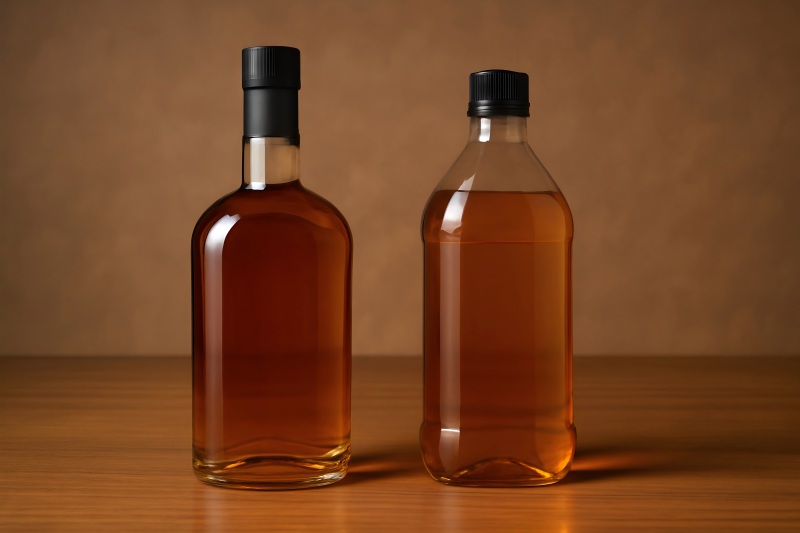
- PET spirits bottles have been designed to “mimic the clarity and shape associated with traditional glass spirits bottles,” meaning the consumer experience remains “as close as possible” to glass in terms of appearance and feel.
However, such adoption tends to be for lower-cost lines, travel-friendly sizes, or products where long-term aging/storage isn’t a priority.
Potential Drawbacks and Risks of PET for Liquor Packaging
While PET offers advantages, there are well-documented drawbacks — particularly for spirits intended for long shelf life, aging, or premium positioning:
- Oxygen and gas permeability — PET allows more oxygen ingress than glass, which can accelerate oxidation, alter aroma/flavor, and degrade sensory quality over time.
- Flavor absorption by polymer — PET polymers may interact weakly with hydrophobic or volatile aromatic compounds in liquor, potentially absorbing them and dulling flavor.
- Perceived lower value/quality by consumers — Many consumers (especially connoisseurs) associate glass with premium spirits. PET may be viewed as “cheap,” undermining brand prestige.
- Recycling / environmental caveats — Although PET can be recycled and has lower production emissions, its environmental footprint depends heavily on local recycling infrastructure. Glass is infinitely recyclable and more consistently managed, especially in many markets.
- Regulatory / consumer acceptance risks — For high-end markets and older consumers, switching to PET may be resisted; and for age-sensitive products (e.g., aged whiskey), long-term stability is uncertain.
Practical Recommendations: Which to Use, When
Given the tradeoffs, here are guidelines for when glass or PET should be preferred, from the perspective of a liquor brand or producer.
| Scenario / Product Type | Recommended Packaging | Rationale |
| Premium spirits / aged liquors / long-term storage / high-end positioning | Glass bottles | Best barrier performance, inertness, preserves flavor/aroma over time, aligns with luxury positioning. |
| Value-line spirits, mass-market products, limited shelf-life, competitive pricing | PET bottles | Lower cost, lightweight, easier transport, suitable for high-volume, price-sensitive markets. |
| Travel-size bottles, export, events, outdoor consumption, convenience-oriented lines | PET bottles | Shatter-resistant, lightweight, easier, and cheaper to ship or carry. |
| Eco-conscious brands operating in regions with good recycling infrastructure | Either — but PET may offer a lower carbon footprint and shipping emissions. | If PET recycling works well locally and consumer acceptance is managed, PET may align with a sustainability narrative. |
| Product lines emphasizing tradition, craftsmanship, and heritage | Glass bottles | Glass reinforces traditional, premium brand image; essential for consumer perception of quality. |
For liquor packaging, the choice between glass and PET depends strongly on your brand’s positioning, target market, distribution model, and product shelf-life expectations.
Glass is still the gold standard for maintaining flavor, fragrance, and overall quality over time. It delivers the premium image, luxury feel, and stability that high-end whiskey, aged spirits, or designer liquors demand.
PET offers practical advantages — cost savings, lighter weight, lower shipping costs, reduced breakage — that make it compelling for value-oriented spirits, mass-market products, export markets, or convenience-focused lines.
If you’re a spirits manufacturer deciding on packaging, you may choose a hybrid strategy: use glass for flagship and premium products, while using PET for budget, export, or convenience lines. That way, you optimize both brand value and cost efficiency — without compromising on product quality where it matters most.
The optimal decision depends on the desired use case, market positioning, and customer value.