How Jar Shape Influences Honey Pouring and Scooping
Honey’s high viscosity and sensitivity to crystallization make jar shape critical to usability and efficiency. Container design directly affects pouring, scooping, residue waste, filling performance, and perceived quality. This article explores how different glass honey jar shapes influence honey flow and user experience through practical packaging insights.
Why Honey Behaves Differently From Other Liquids
Before discussing jar shapes, it is important to understand why honey presents unique challenges.
Honey has:
- High viscosity (far thicker than syrup or oil)
- Non-Newtonian flow behavior (flow rate changes with stress and temperature)
- Strong adhesion to surfaces
- Tendency to crystallize, especially raw or unfiltered honey
Because honey flows slowly and sticks to glass, the angle, opening size, internal geometry, and wall height of a jar significantly affect how it exits the container.
In short: the same jar shape that works well for jam or sauce may perform poorly for honey.
The Relationship Between Jar Shape and Pouring Dynamics
When honey is poured, three forces interact:
- Gravity pulls the honey downward
- Adhesion between honey and glass walls
- Air enters the jar to replace the displaced volume
- Jar shape determines how well these forces balance.
Key shape-related factors include:
- Mouth diameter
- Neck length
- Shoulder angle
- Wall height
- Base width
A poorly designed jar can cause:
- Glugging and air blockage
- Uncontrolled dripping
- Honey running down the outside
- Excess residue trapped inside
A well-designed jar improves flow control, cleanliness, and user satisfaction.

Wide-Mouth Jars: Best for Scooping and Thick Honey
Pouring Performance
Wide-mouth jars are not ideal for pouring, especially when honey is thick or partially crystallized. The wide opening allows honey to exit in an uncontrolled mass, often leading to:
- Sudden spills
- Dripping along the rim
- Messy jar exteriors
Scooping Performance
This is where wide-mouth jars excel.
Advantages:
- Easy access for spoons or spatulas
- Minimal obstruction when honey crystallizes
- Allows scraping of sidewalls and bottom
- Preferred for raw, creamed, or infused honey
Best Use Cases
- Raw or unfiltered honey
- Creamed honey
- Honey used in baking or cooking
- Premium or artisanal brands emphasizing usability
Conclusion: Wide-mouth jars optimize scooping but sacrifice controlled pouring.

Narrow-Mouth and Necked Jars: Controlled Pouring
Pouring Performance
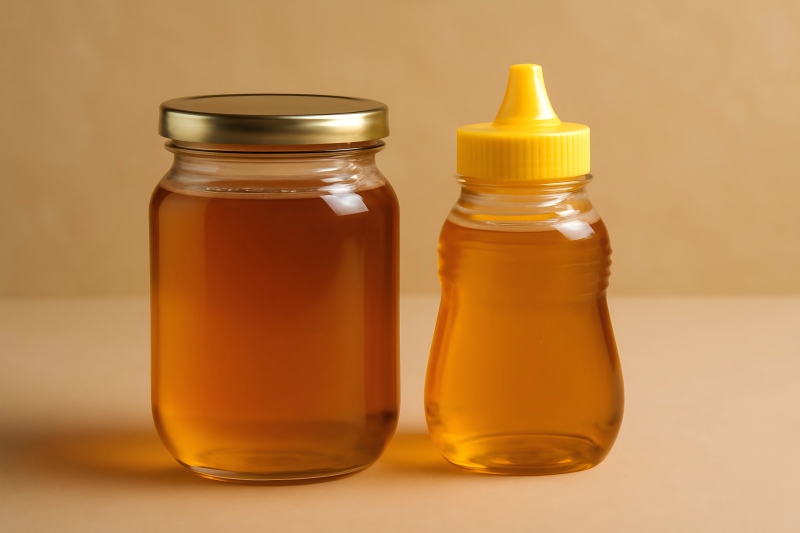
Narrow-mouth jars create a restricted flow path, allowing honey to pour in a thinner, more controlled stream.
Benefits:
- Reduced dripping
- Better directional control
- Cleaner serving over toast or tea
However, flow can slow dramatically at lower temperatures.
Scooping Performance
Scooping is more difficult due to:
- Limited spoon access
- Honey trapped below the shoulder area
- Poor usability once the honey level drops
Best Use Cases
- Liquid, filtered honey
- Honey is marketed for daily pouring
- Table use and breakfast applications
Conclusion: Narrow-mouth jars are ideal for pouring convenience but poor for full product retrieval.
Straight-Wall Jars: Balanced Performance
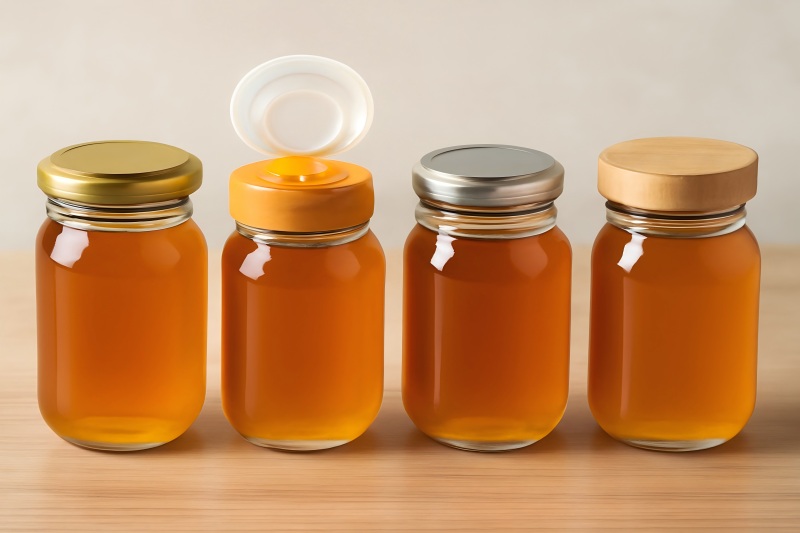
Straight-wall jars have vertical sides with minimal shoulder slope.
Pouring Behavior
- Honey flows more predictably than in curved jars
- Reduced internal pooling
- Easier air replacement during pouring
Scooping Behavior
- Easy to scrape sides
- Minimal honey loss
- Compatible with most spoons
Manufacturing Benefits
- Easier labeling
- Uniform wall thickness
- Lower defect risk
Best Use Cases
- General-purpose honey
- Export markets
- Private-label products
Conclusion: Straight-wall jars offer the best compromise between pouring and scooping efficiency.
Tapered and Curved Jars: Aesthetic vs Function
Curved jars are visually appealing but can complicate honey usage.
Pouring Issues
- Honey pools in shoulder curves
- Increased dripping after pouring
- Inconsistent flow stream
Scooping Issues
- The spoon cannot reach the curved shoulder easily
- Residue accumulation
- Increased product waste
Why Brands Still Use Them
- Premium shelf appearance
- Distinctive branding
- Luxury positioning
Conclusion: Curved jars enhance aesthetics but reduce functional efficiency.
Hexagonal and Square Jars: Stability and Storage Efficiency
Pouring Performance
The shape itself has little effect on pouring unless combined with:
Narrow neck
Sharp shoulders
Scooping Performance
Flat internal surfaces allow:
- Better scraping
- Reduced residue
- Easier access near corners
Additional Advantages
- Higher shelf stability
- Reduced rolling risk
- Efficient carton packing
Best Use Cases
- Gift honey
- Retail shelf optimization
- Export and logistics-focused brands
Conclusion: Polygonal jars combine good usability with logistical advantages.
Jar Height and Aspect Ratio: Hidden Ergonomic Factors
Tall, slim jars and short, wide jars behave differently.
Tall Jars
- Require a higher tilt angle to pour
- Increase the honey acceleration once the flow begins
- More risk of sudden spills
Short Jars
- Lower center of gravity
- More stable during scooping
- Easier one-handed use
Consumer Insight: Shorter jars are perceived as easier and safer for home use, especially for children and elderly users.
Internal Geometry and Honey Residue
Jar shape also affects how much honey remains unused.
Key contributors to residue:
- Sharp internal shoulders
- Narrow neck transitions
- Deep concave bases
Straight internal corners and flat bases allow:
- More complete emptying
- Better perceived value
- Less consumer frustration
Temperature, Crystallization, and Shape Interaction
Honey thickens at lower temperatures and crystallizes over time.
Jar shapes that work well with liquid honey may fail when honey crystallizes.
Best shapes for crystallized honey:
- Wide-mouth jars
- Straight-wall designs
- Low shoulder angles
Poor shapes for crystallization:
- Long-neck jars
- Decorative curves
- Narrow openings
Design Tip: If selling raw or cold-climate honey, prioritize scoop-friendly shapes.
Consumer Perception and Brand Experience
Jar shape silently communicates usability.
Consumers subconsciously associate:
- Easy scooping → honesty, value, practicality
- Clean pouring → refinement, convenience
- Excess residue → waste, frustration
A jar that frustrates users can negatively affect repeat purchase, even if the honey quality is excellent.
Practical Recommendations for Honey Brands
Choose wide-mouth jars if:
- Honey is raw or creamed
- Scooping is the primary usage
- Sustainability and full usage matter
Choose narrow or necked jars if:
- Honey is fully liquid
- Pouring is the primary usage
- Table presentation is key
Choose straight-wall jars if:
- You want universal usability
- Export and automation are priorities
- Private-label flexibility is needed
Jar shape is not merely a design choice—it is a functional interface between honey and the consumer.
By influencing pouring control, scooping ease, residue waste, and user satisfaction, jar shape directly affects:
- Daily usability
- Perceived product quality
- Brand trust and repeat purchases
For honey producers and packaging buyers, selecting the right jar shape means balancing fluid behavior, consumer habits, aesthetics, and logistics. When these factors align, the result is not just better packaging—but a better honey experience from the first pour to the last spoon.