How to Choose the Right Capacity of Glass Honey Jar for Your Product Line
Selecting the right honey jar capacity involves more than simply choosing an attractive-looking container. The capacity of your glass honey jar plays a pivotal role in:
- Product appeal and consumer convenience
- Packaging cost and profitability
- Logistics, shipping, and storage efficiency
- Shelf life, fill weight consistency, and regulatory compliance
- Brand positioning and differentiation
A misstep in capacity selection can lead to increased costs, customer dissatisfaction, or inventory inefficiencies. This article guides you through all the relevant considerations and helps you arrive at an optimal set of jar sizes for your honey product line.
Glass Honey Jar Trends
- Within the jars and containers market, the 10–50 oz (≈ 300 ml to 1.5 L) capacity segment holds the largest share, as it balances usability and storage.
- Glass is showing increasing preference over plastic in premium food packaging, due to perceived safety, inertness, and recyclability.
- In the mason-jar style packaging segment, 8 oz and 16 oz capacities dominate, accounting for over 50 % of revenue in that market.
These macro trends suggest that mid-range glass jar sizes (neither too small nor too large) are commercially attractive and likely to perform well in many markets.
Understanding Standard Glass Honey Jar Sizes
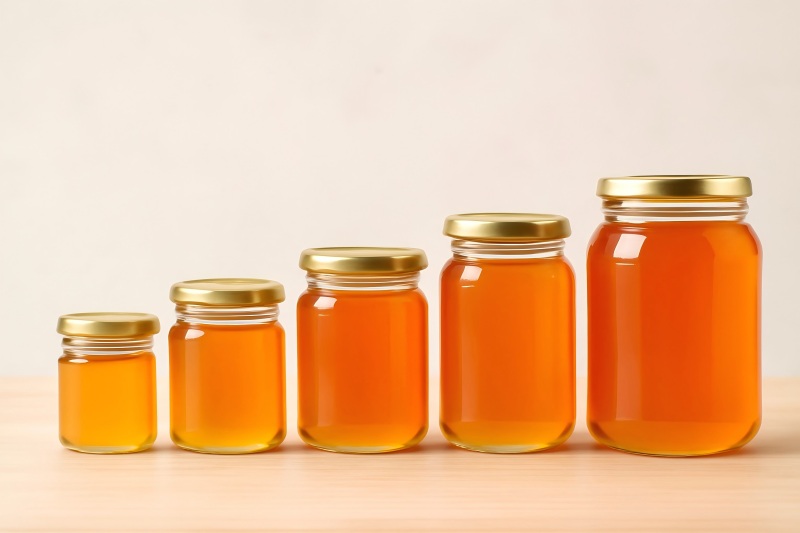
Most honey producers use common jar sizes that match consumer buying habits. Below are some of the most widely adopted glass honey jar capacities:
| Jar Capacity | Ounces (oz) | Milliliters (ml) |
| 1.5 oz | 45 ml | Sampler sets, event favors |
| 3 oz | 90 ml | Gift boxes, specialty kits |
| 6 oz | 180 ml | Premium or seasonal variants |
| 8 oz | 240 ml | Mid-range everyday use |
| 12 oz | 355 ml | Popular for retail distribution |
| 16 oz | 480 ml | Standard for family use |
| 32 oz | 960 ml | Bulk, foodservice, refill jars |
Define Your Target Market and Buyer Preferences
Are you selling to gift buyers, bulk purchasers, or everyday users? Choosing the right capacity depends on who your core customers are:
- Gourmet/Gift Market → 1.5–6 oz glass jars work best. Customers value uniqueness over volume.
- Retail/Everyday Market → 8–16 oz jars are the standard. Customers expect value and usability.
- Foodservice/Wholesale → 16–32 oz sizes reduce packaging and shipping costs per unit.
Tip: Start with 2–3 capacities that reflect different customer types (e.g., 3 oz for gifts, 12 oz for stores, 32 oz for bakeries).
Consider Product Presentation and Brand Image
Size affects not just cost—but visual perception. Larger jars often communicate abundance, while smaller jars may signify premium exclusivity.
| Jar Size | Perceived Message |
| Small (1.5–3 oz) | Luxury, limited edition, sampling |
| Medium (8–12 oz) | Everyday quality, trusted family brand |
| Large (16–32 oz) | Value, practical for bulk users |
Choose capacities that align with your branding. If your honey is raw, organic, or floral-infused, smaller jars can reinforce exclusivity.
Match Capacity to Application Use
Ask yourself: How will the consumer use the honey? The answer may affect your size selection.
- Tea sweetening / daily toast → 6–12 oz is ideal for home users
- Cooking or baking → 16–32 oz for kitchen or foodservice applications
- Sampler or tasting → 1.5–3 oz jars allow trial without commitment
- Gift bundles or event favors → small hexagonal or round jars are perfect
Factor in Packaging and Shelf Efficiency
The jar’s size will also affect packaging logistics:
- Smaller jars → higher cost per ml of packaging but great for gift sets and online shipping.
- Larger jars → better unit economics but take up more shelf space.
Shipping Considerations:
| Jar Capacity | More Efficient For… |
| 1.5–3 oz | E-commerce, compact gift boxes |
| 6–12 oz | Supermarket shelves, display boxes |
| 16–32 oz | Bulk orders, low packaging-to-product ratio |
Be sure your packaging supplier or jar vendor offers standard cartons that match your chosen capacities.
Regulatory Labeling and Display Requirements
Smaller jars provide less space for:
- Ingredient lists
- Nutritional facts
- Required barcodes
If you’re planning custom labeling, make sure the jar capacity leaves enough surface area. Especially for markets like the U.S. or EU, labeling space is non-negotiable.
For example:
| Jar Size | Label Area Needed (est.) |
| 1.5 oz | 1.5″ x 0.75″ |
| 6 oz | 2.5″ x 1.25″ |
| 12 oz | 3″ x 2″ |
| 32 oz | 3.5″ x 2.5″ |
Cost, Profit Margin, and Production Line Impact
Glass jar cost increases with volume, but so does honey content. Larger jars require more raw honey and cost more to fill and ship, but per-ounce margins may improve.
| Size | Honey Fill Cost | Jar Cost | Profit Margin |
| 3 oz | Low | High/unit | Moderate |
| 12 oz | Medium | Moderate | High |
| 32 oz | High | High/unit | Moderate–High |
Always calculate cost per 100 ml and gross margin per SKU. This helps you decide if higher capacity jars are worth it, especially if you have automated filling lines.
Glass Jar Shape and Closure Compatibility
Jar volume must be compatible with:
- Lid types (twist-off, lug, cork, honey dippers)
- Jar shapes (hexagonal, round, square)
- Filling speed and sealing process
For example:
- Round 12 oz jar with lug cap → ideal for high-speed capping
- Hexagonal 3 oz with gold twist lid → great for branding and gifting
- Wide-mouth 32 oz → fits honey dipper or spoon directly
The same capacity may look and behave differently depending on the shape—so always prototype before committing.
Seasonal or Limited-Edition Offerings
Using varying capacities can help diversify your catalog:
- Holiday gift packs → smaller capacities with unique labels
- Summer campaigns → squeeze-friendly jars in mid-range sizes
- Bulk promotions → large jars offered for a limited time
This keeps your product line fresh and engages multiple customer segments.
Summary Table: Which Jar Capacity Suits Which Goal?
| Objective | Recommended Jar Capacity |
| Launch a gift-sized sampler | 1.5–3 oz |
| Build a retail-ready core SKU | 8–12 oz |
| Reach foodservice customers | 16–32 oz |
| Maximize label space | 12–32 oz |
| Optimize for e-commerce shipping | 6–12 oz |
| Diversify offerings | 3 sizes: small, medium, large |
Choosing the right capacity of glass honey jar isn’t just about volume—it’s about brand positioning, consumer behavior, shipping efficiency, and production economics. Whether you’re a boutique beekeeper or a high-volume packer, aligning jar size with your product strategy ensures success on the shelf and beyond.
Start small, test your market, and expand strategically. The right jar size can sweeten more than just your product—it can transform your brand appeal.